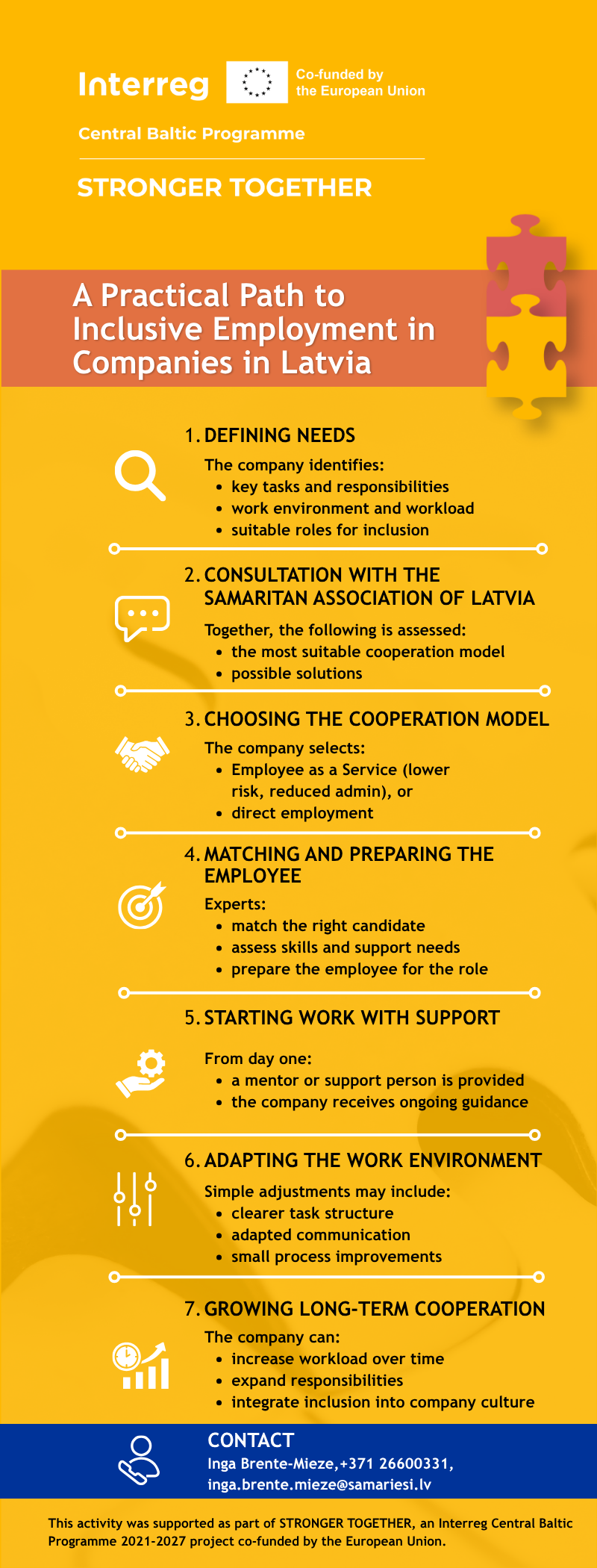
I projektet ”Stronger Together” som Coompanion Östergötland har tillsammans med organisationer i Lettland arbetar vi för att matcha arbetskrafts behov hos arbetsgivare med arbetskraftsutbud hos olika målgrupper. Vi i Östergötland har fokus på personer inom NPF-spektrat och i Lettland har de personer med intellektuell funktionsnedsättning som målgrupp. Nu har våra lettiska parter tagit fram en ”sjustegsraket” för lyckad anställningsprocess som de beskriver nedan.
Employee as a Service: A Practical Path to Inclusive Employment in Companies
Across Europe, including Latvia and Sweden, the question of how to address labour shortages while fostering a more inclusive work environment is becoming increasingly important. Within the Stronger Together project, an approach called “Employee as a Service” is being developed, offering a structured and practical solution for companies willing to engage people with intellectual and mental disabilities in the labour market.
This approach is based on collaboration between companies and social enterprises or organisations acting as intermediaries, providing support to both the employer and the employee throughout the entire employment process. As a result, businesses benefit from reduced risk and administrative burden while ensuring high-quality and sustainable outcomes.
How does this model work in practice?
The process begins with identifying the company’s needs. In cooperation with project partners or social enterprises, job tasks, the work environment, and potential roles suitable for people with special needs are analysed. This step helps identify the most appropriate and tailored solutions for each company.
In the next stage, the employer selects the most suitable form of cooperation. One option is the “Employee as a Service” model, where employment is organised through a social enterprise that takes on coordination and support functions. Alternatively, companies may choose direct employment while still receiving expert support.
This is followed by candidate selection and preparation. Specialists involved in the process assess the skills and needs of candidates, provide necessary training, and support their transition into employment. Importantly, companies do not need to manage this process independently – it is carried out in close cooperation with experienced partners.
Continuous support throughout the process
One of the key advantages of this model is ongoing professional support. Experts assist employees in adapting to the workplace while also advising employers on work organisation, communication, and necessary adjustments.
In practice, workplace adaptations are often simple—such as clearer task structuring or minor process adjustments – yet they can significantly impact employee performance and successful integration into the team.
Additionally, companies are provided with educational materials and training that help them better understand the target group, reduce stereotypes, and build a more inclusive organisational culture.
Latvia’s experience as a practical example
In Latvia, this approach is actively implemented by the Samaritan Association of Latvia in cooperation with the social enterprise “Social Workshops”, providing both the “Employee as a Service” model and support for companies choosing direct employment.
This experience serves as a practical example that can be transferred and adapted to other regions, including Sweden, where similar approaches are being developed in cooperation with social economy organisations.
Benefits for businesses and society
It is important to emphasise that this approach is not only a social responsibility initiative – it is also an effective business solution that:
- helps address labour shortages,
- reduces risks through professional support,
- improves company reputation and internal culture,
- increases employee loyalty and motivation.
At the same time, it creates a positive societal impact by fostering a more inclusive labour market and reducing stereotypes about people with special needs.
A step towards a more inclusive future
“Employee as a Service” provides companies with a clear, structured, and safe way to gradually implement inclusive employment practices. By combining business needs with professional support and cross-sector collaboration, this approach contributes to sustainable solutions – both for business development and for the overall well-being of society.
This activity was supported as part of STRONGER TOGETHER, an Interreg Central Baltic Programme 2021-2027 project co-funded by the European Union.
Karlīne Jākabsone
“Stronger Together” project manager
Valmiera Development Agency